
Last Updated: October 26, 2026
Quick Summary
The best ways to prepare for job interviews start with the job posting, not with rehearsing answers: read the description three times, research the employer for 30 minutes, and build a written checklist. Draft six STAR examples, practice out loud, and prepare four or five questions to ask. Confirm logistics one business day ahead and test your video setup early.
- Read the job posting three times with a pen, circling every skill named twice.
- Spend 30 minutes researching the organization’s website, mission page, and recent news.
- Draft six STAR examples covering likely behavioral questions before the interview.
- Confirm the time, address or link, and interviewer’s name one business day ahead.
- Ask for disability accommodations when you schedule the interview, not after.
Table of Contents
- Start With the Job Description and the Employer
- Build a Job Interview Preparation Checklist
- Practice Common Job Interview Questions and Answers
- Use STAR Method Interview Examples That Show Results
- Prepare Questions to Ask in a Job Interview
- Set Up for Video, Phone, and Panel Interviews
- Evaluate the Employer and Spot Warning Signs
- Get Coaching and Placement Support From Able Inc.
- Frequently Asked Questions
Start With the Job Description and the Employer
The best ways to prepare for job interviews begin with the job posting itself, not with rehearsing answers. Most candidates skip straight to practice questions. That is backwards. The posting tells you exactly what the interviewer will ask about, and the employer tells you what kind of answer they want to hear.
Interview preparation is the work of matching your real experience to the specific requirements of one role at one organization. It is not memorizing scripts.
Read the Posting Like an Interviewer
Print the job description and read it three times with a pen in hand. Interviewers build questions directly from the duties and qualifications listed there, so every line is a clue.
- Circle every skill the posting names twice.
- Underline each duty you have done before, even informally.
- Star the requirements you cannot fully meet yet.
- Note the words the employer repeats, such as “team,” “independent,” or “detail.”
Those repeated words reveal the culture. A posting that says “fast-paced” five times is telling you the interview will test how you handle pressure.
Research the Organization Before You Apply
Company research is the difference between a candidate who wants any job and one who wants this job. Spend 30 minutes on the organization’s website, its mission page, and recent news.
Look for three things: what the organization does, who it serves, and one recent change you can mention. That last part matters. Saying “I saw you recently expanded your training program” proves you did the work. A guide to researching employers from the U.S. Department of Labor offers a solid starting framework for what to check.
Build a Job Interview Preparation Checklist
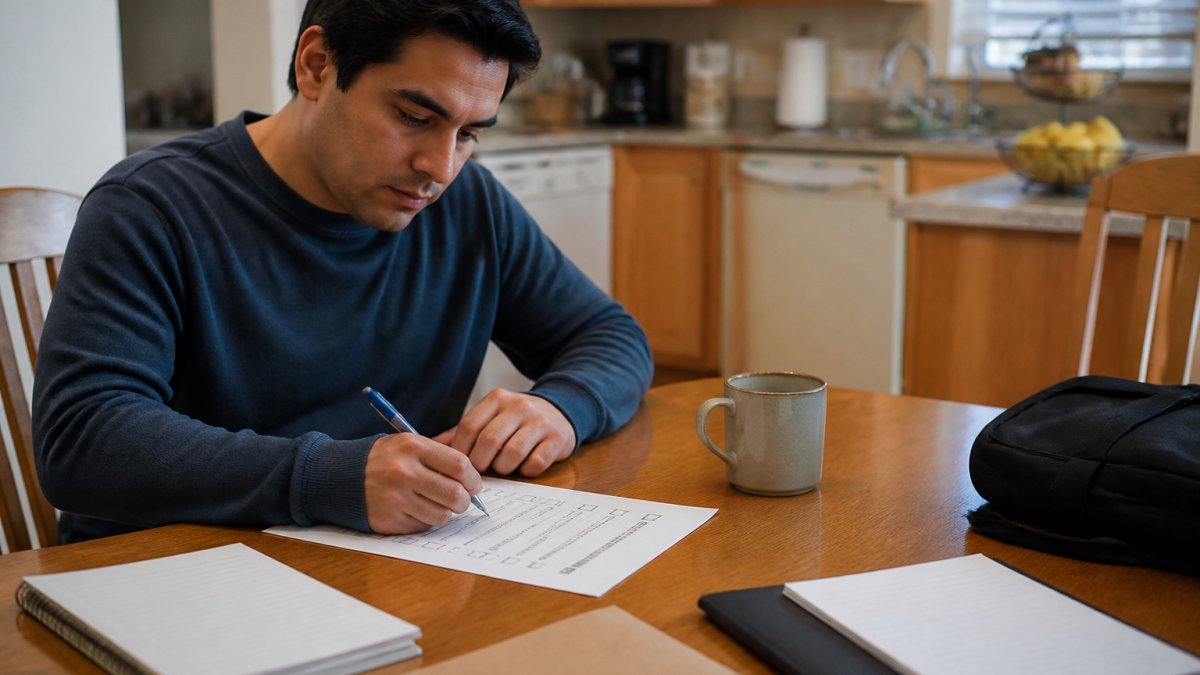
A job interview preparation checklist turns a stressful week into a manageable set of tasks. Write it down and check items off; the visible progress keeps nerves in check.
Your Two-Week Timeline
| When | Task | Time Needed |
|---|---|---|
| Days 14-12 | Read the posting, research the employer, save the job description | 2 hours |
| Days 11-9 | Draft STAR examples for six likely questions | 3 hours |
| Days 8-6 | Practice answers out loud, run one mock interview | 2 hours |
| Days 5-3 | Prepare your questions, confirm logistics, choose attire | 1 hour |
| Days 2-1 | Test video setup or plan the route, review notes, sleep early | 45 minutes |
Treat the hours as ceilings, not quotas. If you have only three evenings before the interview, compress to the three highest-value tasks: read the posting, draft four STAR stories, and confirm logistics. A short, focused plan beats a long one you abandon.
The Day-Of Sequence
Most candidates prepare for the interview and then improvise the morning. Build a fixed sequence instead, so the hour before you log on or walk in is automatic.
- Two hours before: Eat a real meal and drink water. Hunger reads as nerves on camera and in person.
- Ninety minutes before: Read your four to six STAR stories once. Do not reread the whole job posting; it invites last-minute panic.
- One hour before: For in-person interviews, leave earlier than the map says. Arriving 10 to 15 minutes early is standard; arriving 30 minutes early puts pressure on the front desk. For video interviews, join the lobby 5 to 10 minutes early, not 20.
- Fifteen minutes before: Silence your phone, close extra browser tabs, and put notes at eye level beside the camera or on the table in front of you.
Set two alarms: one to start getting ready and one to stop preparing. The second alarm protects you from over-rehearsing in the final minutes, which is when scripts start to sound robotic.
What to Bring and What to Confirm
Confirm the time, address or video link, and the interviewer’s name one business day ahead. A short confirmation message is enough:
“Hi [Name], I’m confirmed for [time] on [date] for the [role] interview. Should I check in at the front desk or call a specific number when I arrive? Thank you, [Your name].”
That message does three things: it confirms the logistics, it surfaces a last-minute change while you can still adjust, and it puts your name in front of the interviewer the day before.
Bring or have within reach:
- Photo ID and any documents the employer requested
- Printed copies of your resume and a list of references
- The job description, folded in your bag or open in a second window
- Your written questions for the interviewer
- A pen that works and a small notebook
Do not rely on the meeting link alone. Save the interviewer’s phone number or the recruiter’s email before the interview starts. If the video platform fails, a quick call or email with “I’m having trouble joining, can we use this number?” keeps the interview alive instead of losing the slot.
Practice Common Job Interview Questions and Answers
Common job interview questions and answers follow predictable patterns, which is good news. Interviewers ask about your background, your skills, your fit, and your goals. Prepare one strong example for each area and you will cover most of what comes up.
Practice out loud, not in your head. Record yourself once and listen back. It feels awkward. Do it anyway.
Strengths, Weaknesses, and Career Goals
Answer strengths with evidence, not adjectives. “I am reliable” means little. “I was never late in two years at my last volunteer role” means something.
For weaknesses, name a real one and the step you are taking to manage it.
Career goals should connect to the role. Explain how this position fits the next step you want to take, and keep it short.
Use STAR Method Interview Examples That Show Results
STAR method interview examples give your answers structure: Situation, Task, Action, Result. Behavioral questions (“Tell me about a time when…”) are asking for a story, and STAR keeps that story tight.
Here is a template you can fill in before the interview:
Situation: At [place], we faced [problem].
Task: I was responsible for [your specific duty].
Action: I [the exact steps you took].
Result: As a result, [outcome, with a number if you have one].
Write six of these in advance. The federal government’s guidance on interview techniques describes behavioral interviewing in more detail if you want to understand what employers are trained to look for.
Prepare Questions to Ask in a Job Interview
Questions to ask in a job interview should be about the work, not just the perks. Prepare four or five, because you will likely use two or three. The stronger move most guides skip: treat the interviewer’s answers as evidence about whether you want the job, not just as a box to check. You are evaluating the employer at the same time they are evaluating you.
Questions That Reveal How the Job Actually Works
- What does a typical day look like in this role?
- How is success measured in the first six months?
- What training or support does the team offer new hires?
- What is the biggest challenge the person in this role will face?
- Who would I work with most closely, and how does that team make decisions?
That last question is uncomfortable and useful. A clear answer, promotion, internal move, retirement, tells you the role has a path. A vague or defensive answer tells you to listen harder to the rest of the conversation.
How to Use the Answers to Evaluate Fit
Listen for specifics. An interviewer who can describe the first 90 days, name the team, and explain how performance is reviewed is usually describing a role that exists.
A simple method: after the interview, write one sentence for each question you asked, summarizing what you heard. If two or more of those sentences are vague or contradictory, treat it as a signal to ask a follow-up before accepting an offer.
Warning Signs Worth Noting
An interview is a two-way review. Watch how the interviewer treats you and how the team talks about its own people.
- The interviewer cannot describe the job clearly.
- Staff seem afraid to speak or contradict each other.
- Questions focus on what you cannot do rather than what you can.
- The schedule or pay described differs from the posting.
- The interviewer speaks negatively about former employees or current staff.
Prepare questions that do double duty: they should help you sound informed and help you decide. If an answer makes you less interested in the job, that is the preparation working, not failing.
Skip salary and schedule questions in the first interview unless the employer raises them. Ask about the job fit and the team instead, and save compensation for the offer stage or a dedicated conversation with the recruiter.
Set Up for Video, Phone, and Panel Interviews
The interview format changes your preparation, not just your nerves. A video interview rewards a clean background and tested technology. A phone interview rewards a clear voice and good notes. A panel interview rewards steady eye contact and answers aimed at the whole group. Mastering these distinct settings often requires specialized interview preparation to ensure your professional presence remains consistent regardless of the specific technical environment.
Video Interview Setup and Troubleshooting
Test your camera, microphone, and internet connection the day before. Sit with a light source in front of you, not behind. Put your phone on silent and close extra browser tabs.
- Join the meeting link ten minutes early.
- Keep notes taped beside the camera, at eye level.
- Have a backup phone number in case the connection drops.
Adjusting for Career Stage and Disability Accommodations
A first job interview and a return-to-work interview need different preparation. First-timers should lean on school, volunteer, and life examples.
If you need an accommodation, ask for it when you schedule the interview. Extra time, a quiet room, a written copy of questions, or a support person are reasonable requests under the Americans with Disabilities Act guidance from the EEOC.
Evaluate the Employer and Spot Warning Signs
An interview is a two-way review. You are checking whether the employer is a good fit, not just hoping to be chosen. Watch how the interviewer treats you and how the team talks about its own people.
Warning signs worth noting:
- The interviewer cannot describe the job clearly.
- Staff seem afraid to speak or contradict each other.
- Questions focus on what you cannot do rather than what you can.
- The schedule or pay described differs from the posting.
Trust your read. A job that feels wrong in the interview rarely feels right on the first day.
Get Coaching and Placement Support From Able Inc.
Preparing alone is hard, and you do not have to. Able Inc. has supported adults with disabilities in the Central Valley since 1960 from our 37,000-square-foot facility, pairing personalized coaching in job searching, resume writing, and interview preparation with hands-on workplace skills training.
If you want structured help, explore our disability support programs and employment services to see how coaching works. Ready to ask about placement or a program? Contact Able Inc. and we will walk you through the options. You can also browse open roles at Able Inc. if you would like to join our team.
Frequently Asked Questions
How early should I start preparing for a job interview?
Two weeks gives you enough time to research the employer, draft and practice answers, and sort out logistics without cramming. If the interview is sooner, focus on the essentials first: reread the job description, write three STAR examples, and confirm the time, location, and format. Even one focused hour of job interview preparation the night before is better than none, but spreading the work over several days helps you remember your answers under pressure.
What should I bring to a job interview?
Bring printed copies of your resume, a list of references with contact details, a notepad and pen for notes, and the name and title of the person you are meeting. Carry the job description so you can refer to position requirements. For in-person interviews, bring directions and a backup phone number. For video interviews, have your resume open on screen and a glass of water nearby. Arrive 10 to 15 minutes early and silence your phone before you walk in.
What are good questions to ask in a job interview?
Ask about the day-to-day work, how success is measured in the first 90 days, and what training or support is available. Questions like ‘What does a typical week look like in this role?’ and ‘How does the team handle feedback?’ show genuine interest. Avoid questions about salary and time off in the first interview unless the interviewer raises them. Prepare three to five questions so you have backups if some are answered during the conversation.
How can I practice answering interview questions if I have no one to rehearse with?
Record yourself on your phone answering common job interview questions and watch it back. You will notice filler words, pacing, and whether your examples include a clear situation, task, action, and result. Practice out loud in front of a mirror, or use a video call with a friend or coach. Mock interviews with a vocational coach, like the personalized coaching at Able Inc., give you real-time feedback on body language, eye contact, and confidence before the actual interview.
The interview is not a test of whether you are worthy. It is a conversation about whether this job fits your skills, and preparation is what lets you show those skills clearly. Able Inc. offers personalized coaching, mock interview practice, and long-term follow-up support after you are hired, so you are not left to figure it out alone. Get started with Able Inc. and walk into your next interview ready.

