
Last Updated: October 30, 2026
Quick Summary
Disability employment services in Tulare County connect adults with disabilities to real jobs through skills training, placement help, and ongoing coaching. Able Inc. has been based in Visalia since 1960, providing job training, life skills development, and employment placement services for adults with disabilities.
- Most programs serve adults 18 and older with developmental, intellectual, or physical disabilities.
- A strong placement team maps skills, matches roles, prepares interviews, and stays involved after day one.
- Supported employment continues job coaching after hire, while standard placement ends at hire.
- Ask for the provider’s most recent DOR or Regional Center vendor number to verify status.
- Starting intake before the job search shortens the gap between wanting to work and working.
Table of Contents
- What Disability Employment Services in Tulare County Actually Offer
- Disability Job Placement Services: How the Hiring Process Works
- Job Training for Adults with Disabilities: Building Skills That Stick
- Supported Employment Services and Job Coaching for People with Disabilities
- How to Compare Providers: Eligibility, Documentation, and Costs
- Start Your Job Search with Able Inc. in Visalia
- Frequently Asked Questions
What Disability Employment Services in Tulare County Actually Offer
Disability employment services in Tulare County connect adults with disabilities to real jobs, not just job-readiness classes, combining skills training, placement help, and ongoing coaching. Specialized programs often extend these local efforts by offering focused job placement training to prepare candidates for specific technical roles in the workforce.
Disability employment is the practice of preparing, placing, and supporting workers with disabilities in paid jobs through training, coaching, and employer partnerships.
Who These Programs Serve and How Eligibility Works
Most programs serve adults 18 and older with developmental, intellectual, or physical disabilities. In this region, many participants come through referral from the Central Valley Regional Center.
Eligibility usually comes down to three things:
- A documented disability
- Age 18 or older
- A referral or intake meeting with the provider
Documentation typically means an Individual Program Plan or similar record from the referring agency. Ask the provider what they need before your first visit. Missing paperwork is the most common reason an intake gets delayed.
Disability Job Placement Services: How the Hiring Process Works
A strong placement team does four things in order:
- Meets with the job seeker to map skills and interests
- Matches those skills to open roles at partner businesses
- Prepares the person for the interview and any work sample
- Stays involved after the first day
The employers matter as much as the process. Able Inc. works with local businesses to create supportive work environments.
Job Training for Adults with Disabilities: Building Skills That Stick
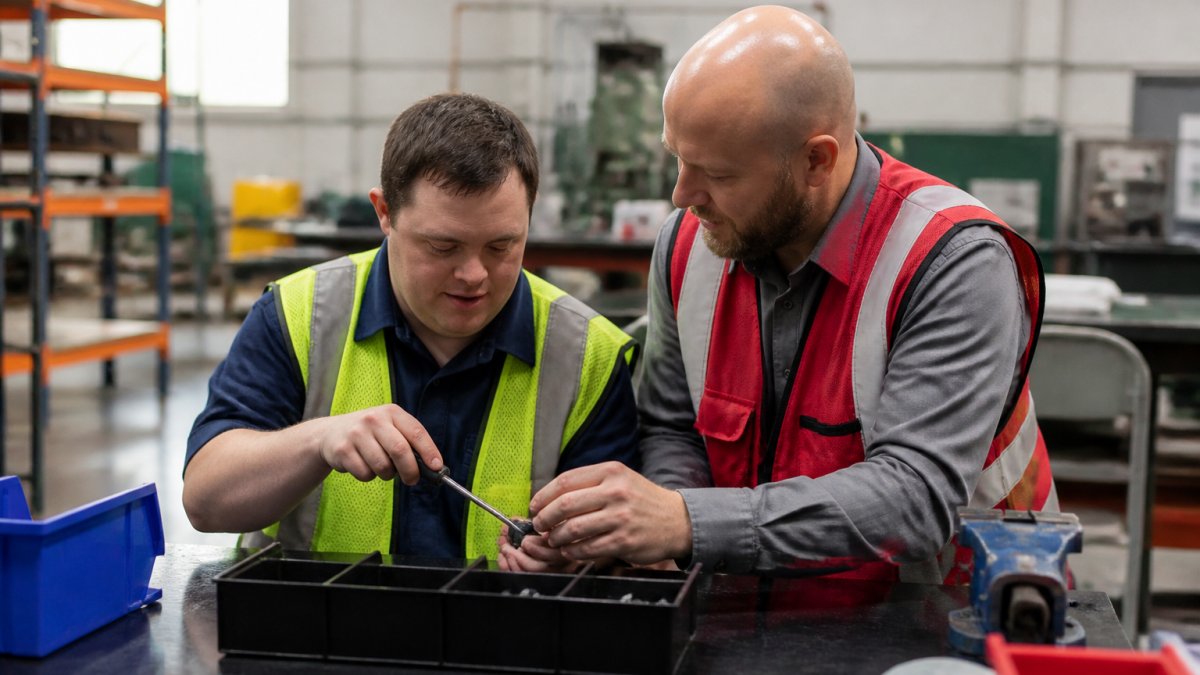
Training sticks when it happens on real tasks, not worksheets. Our 37,000-square-foot facility in the Visalia Industrial Park is where participants build workplace skills.
The goal is a portable work ethic: showing up on time, finishing a task, and asking for help when stuck.
Work Readiness and Skills Assessment
Before training starts, a skills assessment maps what a person can already do and where they need practice. The assessment covers:
- Physical tasks and stamina
- Attention and task completion
- Communication and teamwork
Results shape the training plan. Someone strong in hands-on work but anxious about customer contact gets a different plan than someone who thrives talking to people.
Supported Employment Services and Job Coaching for People with Disabilities
Supported employment is the part of disability employment that most guides skip. Placement gets the attention; supported employment is what keeps the job. It is a distinct service model with its own referral routes, funding, and mechanics.
Supported employment is a service model that places a person with a disability in a competitive, integrated job and then provides ongoing job coaching and follow-along support to help them keep it. Standard placement ends at hire; supported employment continues after.
Vocational Rehabilitation and Supported Employment Pathways
Supported employment may be accessed through referral pathways including the California Department of Rehabilitation and the Central Valley Regional Center.
Ask the referral agency directly whether supported employment services are available to you.
The referral question to ask any provider is not “do you offer job coaching?” but “are you a vendored supported employment provider for DOR or the Regional Center, and what is your authorization process?” That answer tells you whether the service is funded and durable.
What Job Coaching Actually Looks Like
Ongoing support can include coaching, follow-up check-ins, and help with workplace adjustments. Ask any provider how their support is structured after placement. Families and supporters can also explore volunteer opportunities to get involved.
Job Coaching for People with Disabilities: What Ongoing Support Looks Like
Ongoing support is tailored to each person. Ask any provider directly whether you will work with the same person throughout.
Accommodations and Accessibility During the Job Search
Ask how the provider handles workplace accommodation requests during hiring and after placement.
How to Compare Providers: Eligibility, Documentation, and Costs
Most guides tell you to “ask questions.” What actually separates providers is whether they can confirm, in writing, that they serve people with disabilities, what they require to open a case, and who pays.
A Verified Disability-Specific Provider Checklist
Before you call, consider confirming these criteria with each provider.
- Disability-specific intake. The provider has a documented intake process for adults with developmental, intellectual, or physical disabilities, not a general job-seeker queue.
- Referral pathways. The provider accepts referrals from the Central Valley Regional Center and, where applicable, from the California Department of Rehabilitation (DOR). Ask which referral sources they routinely accept.
- Eligibility criteria in writing. You can get a one-page summary of who qualifies, what documentation is required, and how long intake takes.
Ask for the provider’s most recent DOR or Regional Center vendor number. A provider that can produce it is almost always a verified disability employment vendor; one that cannot may be a general staffing agency.
Eligibility, Documentation, and Costs: What to Expect
Eligibility for Able Inc. services includes being an adult 18 or older with a disability, and may involve a referral or intake meeting. Documentation is where most intakes stall. Bring or request:
- An Individual Program Plan (IPP) or Individualized Education Program (IEP) if you have one
- A recent psychological or medical evaluation documenting the disability
- Identification and, if applicable, Social Security award letters
- Any prior vocational assessment or work history records
Cost varies by funding source. Confirm the funding source and any fees for assessment, job coaching, or follow-along support in writing before intake.
“No cost” and “covered” are not the same thing. A service can be covered by a funding agency but still require an authorization that takes weeks. Ask how long authorization typically takes so you can plan around it.
Referral Routes and Application Steps
A typical referral path looks like this:
- Identify the funding stream. Regional Center for adults with developmental disabilities; DOR for vocational rehabilitation; or private pay.
- Request a referral or intake meeting. For Regional Center, this usually starts with your service coordinator. For DOR, it starts with an application and an eligibility interview.
- Complete the provider intake. Bring the documentation listed above.
- Complete a skills assessment. This shapes the training and placement plan.
- Sign the service authorization. Confirm what is covered and for how long.
Families often wait until a job is in hand to start this process. Starting intake before the job search shortens the gap between wanting to work and actually working.
Coverage by City and Transportation Access
Service coverage varies by provider. Some serve the whole county; others concentrate on Visalia and nearby communities. Before intake, confirm:
- Service area. Which cities and unincorporated areas does the provider cover?
- In-person vs. remote. Can assessment, coaching check-ins, or training happen remotely, or must they be on site?
- Transportation help. Is transportation assistance available, or does the provider coordinate with local transit and community support programs?
- Language access. Are services available in the languages spoken in your household?
Get the service area and transportation plan confirmed before you sign anything.
Before you call a provider, here is what to confirm and what to bring.
| Item | What to confirm or bring | Note |
|---|---|---|
| Disability-specific intake | Documented intake for adults with disabilities | Not a general job-seeker queue |
| Referral pathways | Accepts Central Valley Regional Center and DOR referrals | Ask which sources they routinely accept |
| Eligibility criteria | One-page summary of who qualifies | Includes documentation and intake time |
| Funding source | Regional Center, DOR, private pay, or blend | Ask what the family pays |
| Accommodation support | Help requesting workplace accommodations | During hiring and after placement |
| Follow-up commitment | How long they stay involved after hire | Whether same job coach is assigned |
| Documentation | IPP or IEP, psychological or medical evaluation | Also ID and Social Security award letters |
| Cost and authorization | Confirm funding source and fees in writing | Ask how long authorization takes |
Start Your Job Search with Able Inc. in Visalia
The gap between wanting to work and actually working usually comes down to support. That is what we build here.
Able Inc. offers personalized coaching in job searching, resume writing, and interview preparation, paired with hands-on workplace skills training and long-term follow-up services. You can contact Able Inc. in Visalia to start intake, or explore our disability support and employment programs to see what fits.
Frequently Asked Questions
What disability employment services are available in Tulare County?
Adults with disabilities in Tulare County can access employment support through a range of providers. Able Inc. in Visalia offers job training, life skills development, and employment placement services, along with long-term follow-up services. Ask each provider what documentation they require before enrolling.
Can employment services help with resumes, interviews, and job placement?
Yes. Able Inc. offers personalized coaching in job searching, resume writing, and interview preparation, along with employment placement services. Ask whether coaching continues after you are hired.
Can I get support after starting a job?
Able Inc. provides long-term follow-up services to support smooth transitions. Before enrolling, ask how often follow-ups happen and who your contact person will be.
What should I ask a disability employment provider before enrolling?
Ask about eligibility and documentation, how personalized the coaching is, and what post-placement support is available. Ask about transportation options if you live far from Visalia, and whether training can be done in person or remotely.
If you have been out of work for a long stretch, the first step is smaller than you think: one conversation about what you can already do. Able Inc. has spent more than six decades helping adults with disabilities in the Central Valley turn that conversation into a paycheck, with personalized coaching, real workplace training, and follow-up that lasts past the first week. Get started with Able Inc. and build a job that sticks.

